Best Books and Courses for Learning Computer Vision
There are many computer vision books and courses, and the best one depends on where you are now. This article does not give a ranked list of titles, because the market changes, new editions appear, and a ranking from a blog post goes out of date quickly. Instead it shows how to choose, what to look for, and how to combine resources with practice so you actually learn.
Always check the current edition, the publication date, and recent reviews before you buy anything.
First, decide your level and goal
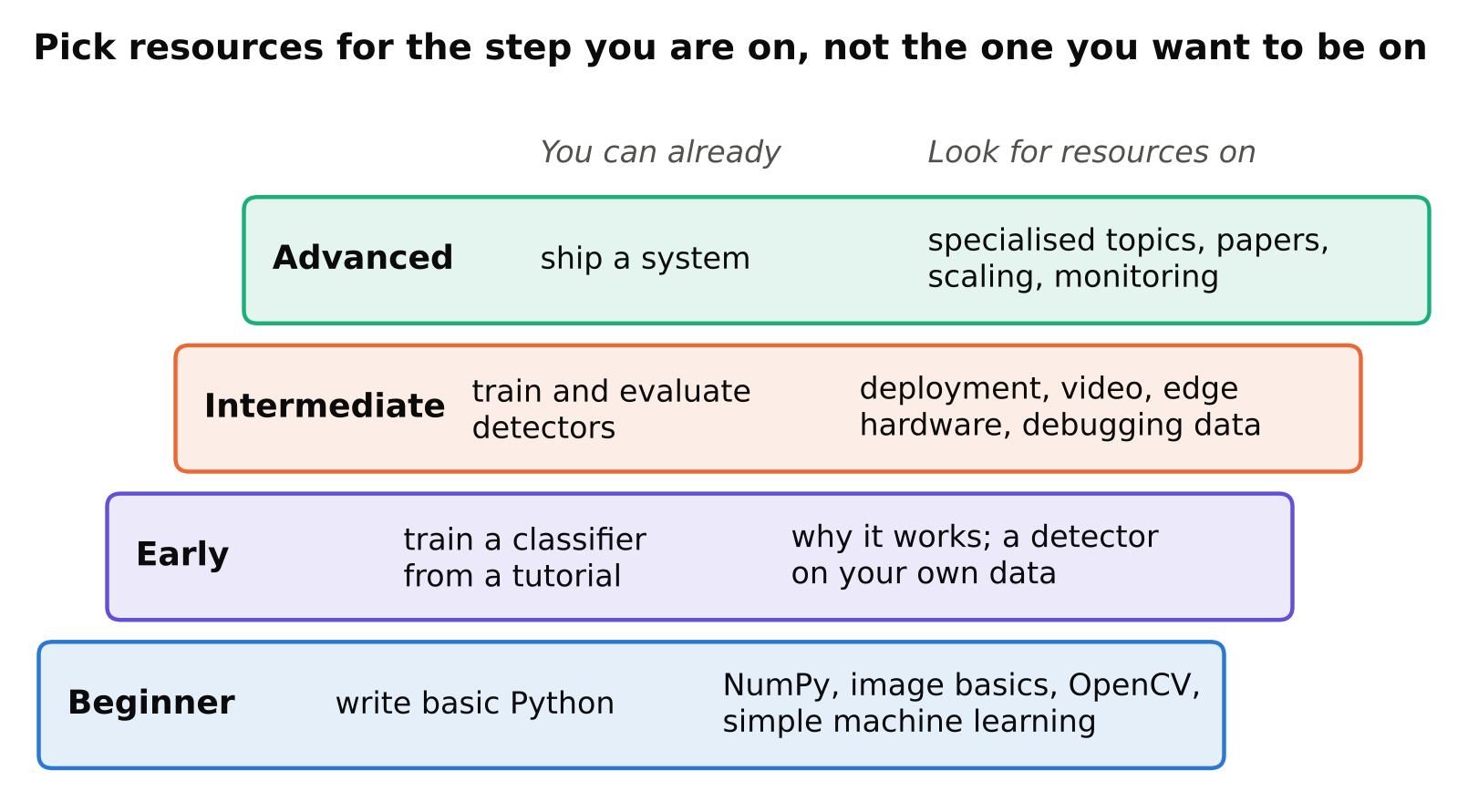
Pick the row that matches you.
| Level | You can already | Your next need |
|---|---|---|
| Beginner | Write basic Python | NumPy, image basics, OpenCV, simple machine learning |
| Early | Train a classifier from a tutorial | Understand why it works; build a detector on your own data |
| Intermediate | Train and evaluate detectors | Deployment, video, edge hardware, debugging data |
| Advanced | Ship a system | Specialised topics, papers, scaling and monitoring |
Your goal also matters. If you want a job or freelance clients, favour practical resources that end with built projects. If you want research, you need more mathematics and paper reading. For a broader path, see the computer vision engineer roadmap.
What books do well
Books are good for depth and for reference.
Strengths: - A well-structured, careful explanation, often better organised than scattered blog posts. - Good for foundations: image formation, filtering, geometry, and the ideas behind neural networks. - Easy to return to when you need to look something up.
Weaknesses: - Fast-moving topics date quickly. Code and library versions in a printed book may no longer run unchanged. - Passive reading feels like progress but is not. You learn by building. - Some books are heavy on mathematics, which suits some readers and blocks others.
How to choose one: 1. Look at the table of contents and compare it with your goal. 2. Read a sample chapter. If you cannot follow the writing style, move on. 3. Check whether the code is available online and when it was last updated. 4. For theory-heavy topics, an older book can still be excellent. For tooling and deployment, prefer recent ones. 5. Look for books that show full projects including data handling and evaluation, not only model architectures.
A good deep learning or computer vision book can be a solid companion to practice. Treat it as a reference you work through with code open, not something to read like a novel.
What courses do well
Courses are good for structure, pace and accountability.
Strengths: - A set order, so you do not have to decide what comes next. - Video explanations and demonstrations can make ideas click faster. - Exercises and assignments force you to apply what you learned. - Some include feedback, a community or a certificate.
Weaknesses: - Quality varies a lot. A polished marketing page does not guarantee good teaching. - It is easy to follow along and copy code without understanding it. - Some courses stay at toy datasets and never touch real deployment problems. - Content can be dated.
How to choose one: 1. Read the syllabus and compare it with your level. Check the prerequisites. 2. See whether it includes graded or open-ended projects. 3. Check the date of last update and whether the tools it uses are still current. 4. Look for previews or free lessons and judge the teaching style. 5. Read independent reviews, and be cautious about reviews that look promotional. 6. Check refund terms and the current price before committing.
An online computer vision course works best when you pair it with your own project, so you apply each module to data you collected yourself.
Free resources
Plenty of good material is free. Official documentation for the tools you use is often the most accurate and current source. This includes OpenCV, PyTorch and Ultralytics. University lecture notes and recorded lectures are also widely available. Public datasets let you practise. The trade-off is that free material is scattered, so you must build your own order, and the roadmap above helps with that.
A study plan that works
The most common failure is consuming without producing. Try a weekly pattern like this:
- Learn a small topic from a book chapter or a course lesson.
- Apply it the same week in code on your own data, however small.
- Write a short note in your own words, including what confused you.
- Revisit the topic a week later, and test yourself without looking.
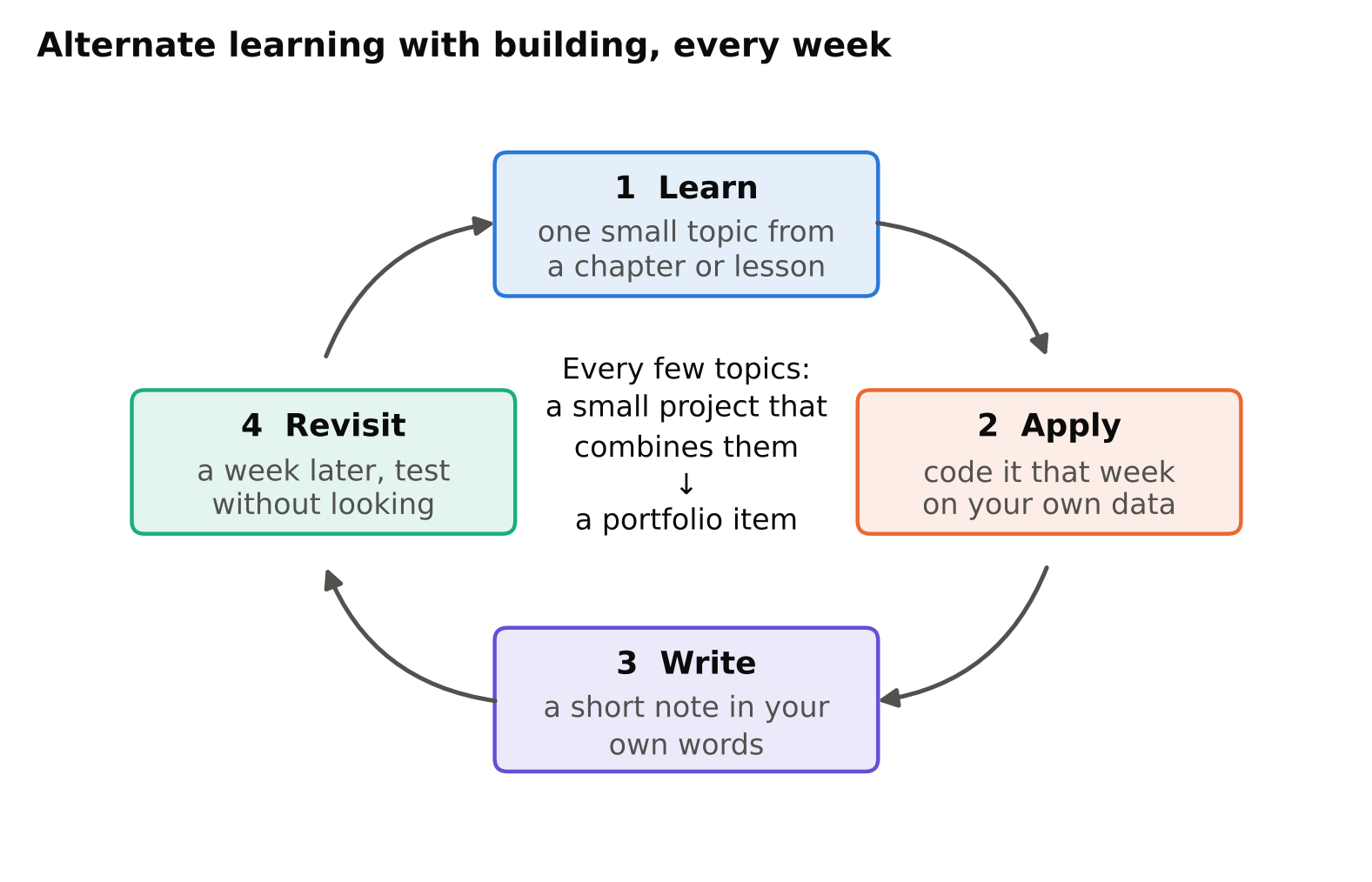
After every few topics, complete a small project that combines them. For example: after OpenCV basics and a detection tutorial, build a script that counts objects in a video. See people counting with line crossing for one such project.
Topics worth covering, and where practice matters most
- Image basics and OpenCV. Do this by coding. See OpenCV essentials.
- Machine learning basics. Understand splits, overfitting and metrics.
- Detection. Read what is YOLO, then train on your own data using train YOLO on a custom dataset.
- Data. Labelling quality and dataset splits matter more than most courses suggest.
- Deployment. Few courses cover it well, so you may need to learn it from documentation and projects. See export YOLO to ONNX.
- Video and systems. Streams, tracking, alerts and monitoring are usually learned on the job, or from project-based material.
Warning signs
Be careful with any resource that:
- Promises a job, a specific income or mastery in a short time.
- Shows only cherry-picked results and no failures.
- Has no way to check your understanding.
- Never mentions licences, data quality, privacy or deployment.
- Uses very old library versions with no update notes.
Using resources while building a portfolio
Whatever you study, turn the output into evidence of your ability: a repository, a short write-up, and a demo. The best learning resource is useless to a future client if you cannot show what you did with it. See build a computer vision portfolio that gets clients.
Checklist
- Decide your level and goal before choosing anything.
- Check edition dates, code updates and recent independent reviews.
- Read a sample chapter or free lesson first.
- Prefer resources with projects, not only lectures.
- Use official documentation as a main reference for tools.
- Alternate learning with applying: build something each week.
- Check current prices and refund terms before buying.
- Turn each finished project into a portfolio item.
Next steps: computer vision engineer roadmap, build a computer vision portfolio that gets clients.