Freelancing in Computer Vision: Winning Your First Jobs
Computer vision looks like a good freelance skill. Many businesses have cameras and images, and few have someone who can turn them into something useful. But the work is risky for freelancers. Clients often misunderstand what is possible, data is poor, and "just detect the thing" can hide weeks of difficulty.
This article covers how to position yourself, how to scope work so you do not lose money, and how to avoid projects that go badly. It is general guidance. Rates, platforms and market conditions change, so treat any specifics as things to check yourself.
Start with what you can honestly deliver
Clients do not buy "computer vision". They buy a result: fewer missed safety violations, an automatic count, a faster inspection, a way to search images. Describe what you can deliver in those terms, and only claim what you have done.
Good areas to define for yourself:
- Task type. Detection, classification, counting, tracking, inspection, OCR-style reading, video alerts.
- Environment. Cloud, server, or edge devices.
- Stage of work. Prototype, a trained model, or a full deployed pipeline with monitoring.
A narrow, clear statement such as "I build and deploy object detection for camera feeds" is easier to hire than "AI developer, anything". Specialising does not stop you taking other work. It makes your pitch believable.
If you are new, build proof first. A few finished, honestly described projects are worth more than a long list of skills. See build a computer vision portfolio that gets clients.
Where first clients come from
There is no secret. The usual sources are:
- Freelance platforms. Easy to start, but crowded and price-sensitive. You will compete with many proposals, so write specific ones.
- Your existing network. Former colleagues, classmates and managers know your work. A short message saying what you now offer can produce leads.
- Content and open work. Articles, demos and open-source tools show how you think. Clients who find you this way are often better matched.
- Agencies and software companies. They sometimes need a specialist for one part of a project and subcontract it.
Expect slow early weeks. Treat the first few jobs as a way to build references, but do not work for free on large pieces.
Scope before you price
Most freelance losses come from unclear scope. Computer vision has a special trap: the same sentence can describe a one-day task or a six-month research problem.
Before quoting, ask:
- What decision or action will the output drive? This tells you which errors matter.
- What data exists? Images, video, labels, camera types, and how many sites. Can you see samples before you quote?
- What does success look like, in numbers? For example, an agreed error rate on a test set that you both approve. Without this, "it does not work well enough" can never be answered.
- Where does it run? Cloud, an on-site server, or small devices. Hardware limits change the model choice.
- Who labels data, and who provides test footage? Labelling is often the largest cost.
- What are the privacy and legal constraints? Footage of people raises extra requirements.
- Who maintains it afterwards? Models drift when conditions change.
Be honest about unknowns. If the data quality is unknown, say the first step is to assess it, and price that step separately.
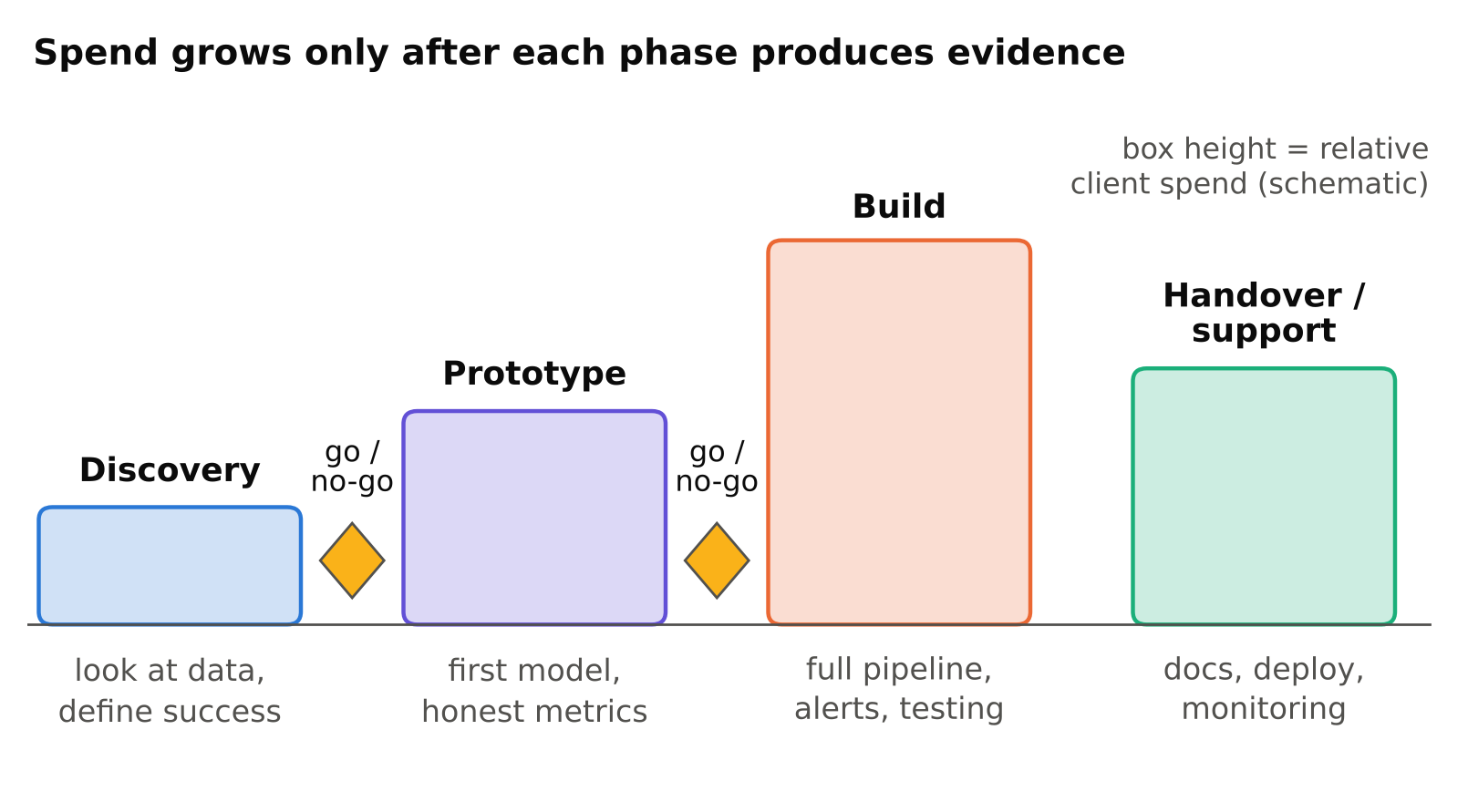
Split the work into phases
A common structure that protects both sides:
| Phase | What it covers | Why |
|---|---|---|
| Discovery | Look at data, define success, test feasibility on a small sample | Removes the biggest unknowns cheaply |
| Prototype | Train a first model, report honest metrics on held-out data | Client sees real evidence before committing |
| Build | Full pipeline, integration, alerts, testing | Larger spend only after feasibility is shown |
| Handover or support | Documentation, deployment, monitoring, fixes | Sets expectations for after delivery |
If the feasibility check fails, you and the client both learn that early, which is a good outcome for them and for your reputation.
Pricing models
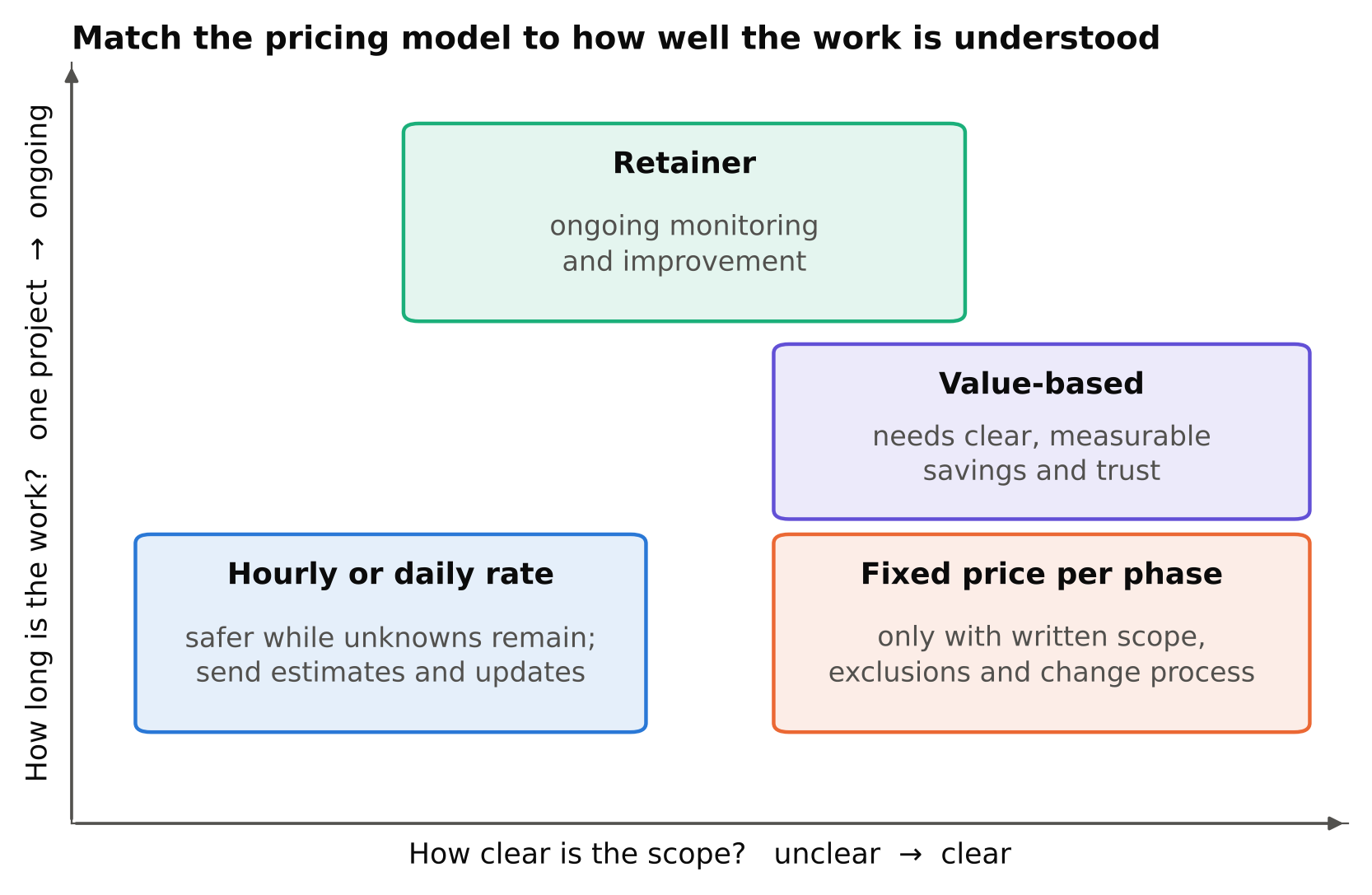
Each model has strengths and risks.
- Fixed price per phase. Clients like certainty. Only use it when scope is clear, and write down what is out of scope and how changes are handled.
- Hourly or daily rate. Safer for uncertain work, but some clients dislike open-ended cost. Provide estimates and regular updates.
- Retainer. Suits ongoing monitoring and improvement.
- Value-based. Price relates to the value delivered. It works for clients with clear savings, but needs trust and a clear definition of the result.
I will not quote rates here, since they vary widely by region, experience and client. Look at current listings and ask peers. Do not price so low that you cannot afford to do careful work, because that leads to rushed, unreliable systems.
Whatever model you use, include in the quote: who supplies data, how many revision rounds are included, cost of cloud or GPU services (who pays), and what happens if the data turns out to be unusable.
Writing a proposal that stands out
Short and specific beats long and generic.
- Restate the problem in your own words, showing you understood it.
- Ask one or two sharp questions that reveal real experience, for example about camera angle, lighting or how errors are handled.
- Propose a first step, such as reviewing sample footage.
- Link to one relevant example, not ten.
- State clearly what you need from the client.
Avoid promising a specific accuracy before seeing data. A confident promise without evidence is a warning sign to experienced clients.
Projects to be careful with
- "We have no data yet, but it should be easy." Data collection and labelling is the project.
- Perfect accuracy expected. No detector is perfect. If the process cannot tolerate any error, the design needs human review or other controls.
- Vague success criteria. Agree measurable targets in writing.
- Unpaid trial of large scope. A small paid discovery is fairer to both sides.
- Surveillance of people without a clear lawful basis. Consider privacy law and ethics, and the harm if the system is wrong. See privacy and ethics in camera analytics. This is not legal advice.
- Clients who will not give you real footage. You cannot validate what you cannot see.
Delivering well
What keeps clients and brings referrals is usually not the model. It is the reliability and communication:
- Test on realistic footage and report weaknesses plainly. Use a process like a pre-deployment testing checklist for vision models.
- Deliver code, documentation, model files and the exact environment, so the client is not locked in. Follow good practice for reproducible environments.
- Check licences of models and libraries before using them in a client product. Some popular detectors are under AGPL-3.0 or GPL-3.0, and commercial use may need a different licence. Check the current terms, and see YOLO licences explained.
- Plan for false alarms and monitoring, not only for the first demo. See reducing false alarms in production.
Checklist
- Describe your offer as a result, in a narrow area you can really deliver.
- Build two or three honest, finished projects first.
- Ask scoping questions about decisions, data, success numbers, hardware and maintenance.
- Price a paid discovery or prototype phase before the full build.
- Put scope, data responsibilities and change handling in writing.
- Never promise accuracy before seeing data.
- Check licences and privacy constraints.
- Deliver code, documentation and a reproducible setup.
Next steps: build a computer vision portfolio that gets clients, computer vision engineer roadmap.