Classification vs Detection vs Segmentation: Pick the Right Task
Before choosing a model, choose the task. Many projects start with "we need YOLO" when the real need is simpler, or harder, than detection. The task decides how much labelling you do, what the model can tell you, and how the system behaves in production. Picking wrongly wastes weeks.
This article compares four tasks and gives a way to choose.
The four tasks
Image classification
The model looks at the whole image and returns a label, for example "ripe" or "unripe", or "OK" or "defective". One image, one answer (or a score per class).
- Output: a class and a score for the whole image.
- Labels needed: one label per image. This is the cheapest to produce.
- Cannot tell you: where anything is, or how many.
Object detection
The model finds each object and returns a bounding box, a class and a confidence. A single image can contain many objects.
- Output: a list of boxes with classes and scores.
- Labels needed: a box around every object of interest in every image.
- Cannot tell you: the exact shape of an object. A box includes background.
Semantic segmentation
The model assigns a class to every pixel. The output is a mask in which each pixel is, say, road, sky, building or person. It does not separate two objects of the same class that touch each other.
- Output: a per-pixel class map.
- Labels needed: pixel-level masks, which are slow to draw.
- Good for: measuring areas of regions, such as how much of a field is covered by a crop.
Instance segmentation
The model finds each object and also gives its exact outline as a mask. Two people next to each other get two separate masks.
- Output: per-object masks, with classes and scores, usually along with boxes.
- Labels needed: a polygon or mask for each object. Costly.
- Good for: counting touching objects, measuring object size or shape, and cutting an object out.
Pose estimation and oriented boxes are related tasks. The Ultralytics package supports several of these, which makes it easy to try neighbouring tasks.
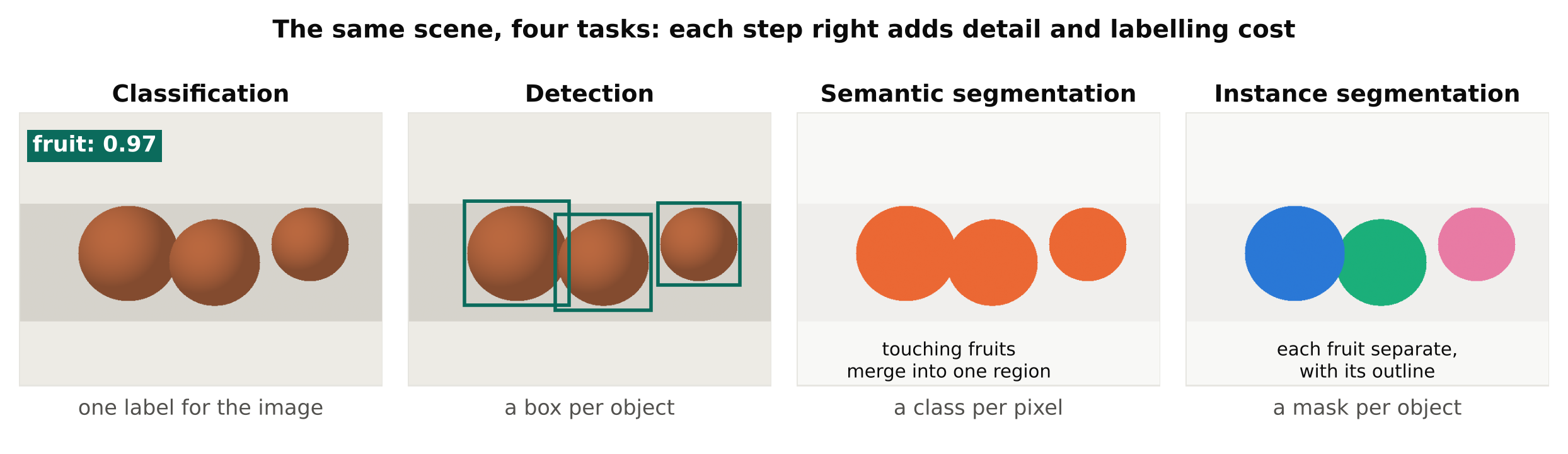
Compare them
| Task | Answers | Label effort | Typical compute | Failure style |
|---|---|---|---|---|
| Classification | What is this image? | Low | Lowest | Wrong label for the whole image |
| Detection | What and where? | Medium | Medium | Missed or extra boxes |
| Semantic segmentation | Which pixels are which class? | High | Higher | Ragged or merged regions |
| Instance segmentation | Which pixels belong to each object? | Highest | Highest | Merged or split instances |
Costs rise as you move down the table, both in labelling and in compute. So the guiding rule is: use the simplest task that answers your question.
A decision guide
Ask these questions in order.
- Is there one thing of interest per image, or is the decision about the whole image? Use classification. Examples: sorting parts that arrive one at a time on a fixture, or deciding whether a lens is dirty.
- Do you need to know where objects are, or how many? Use detection. Examples: counting people at a door, spotting a missing helmet, locating packages.
- Do you need area, outline or shape? Use segmentation. Examples: measuring the size of a spill, finding the extent of damage, estimating the covered fraction of a surface.
- Do touching objects of the same type need to be separated? Use instance segmentation. Semantic segmentation will merge them.
- Do you only need coarse location? A box is probably enough. Do not pay for masks you will never use.
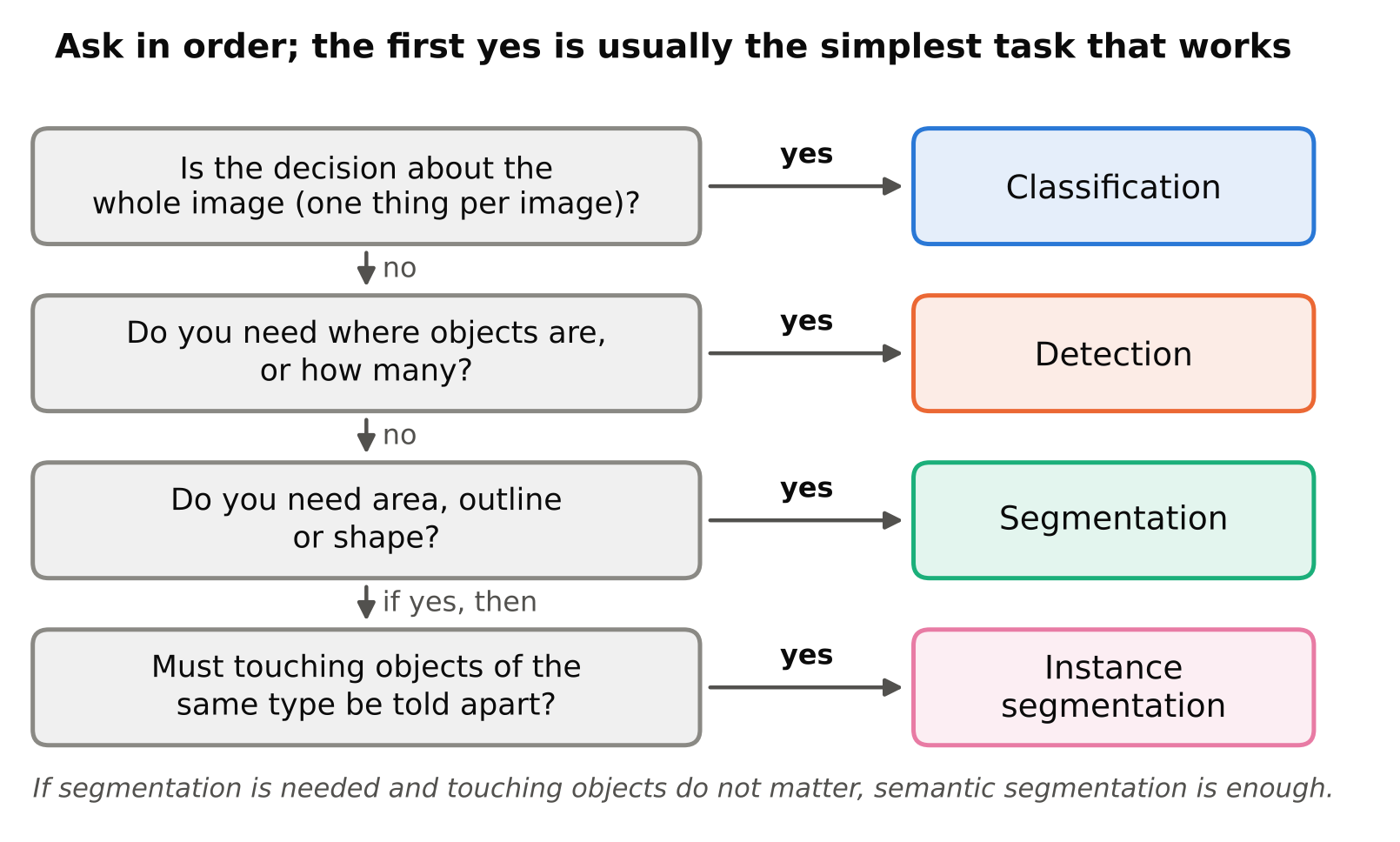
If you are unsure between two, start with the cheaper one and see whether it answers the business question. You can often upgrade later, and the data you labelled may still help. A dataset with masks can be converted into boxes, but boxes cannot be turned into masks.
Examples by situation
| Situation | Suitable task | Why |
|---|---|---|
| Is the product label present on this bottle? One bottle per image | Classification | Whole-image decision |
| How many people are in the queue? | Detection | Need count and rough place |
| Is a worker inside a marked zone? | Detection (plus zone logic) | Needs position of a person |
| What fraction of the surface is corroded? | Semantic segmentation | Area measure |
| How large is each piece of fruit on a belt, with fruit touching? | Instance segmentation | Separate objects and size |
| Is this scene day or night? | Classification | Whole-image property |
Many real systems combine tasks. A detector finds a region, then a small classifier checks the crop. A cascade like this can improve results because the classifier sees the object larger and cleaner than the detector did. It also adds one more model to maintain, so use it when it solves a real problem.
Pitfalls when choosing
Using detection when classification is enough
If your camera always frames one object in the same place, a classifier is simpler, faster to label and often more robust. A detector adds label work and extra failure modes: boxes that drift, duplicates, thresholds.
Using classification when objects vary in number
Classifying a frame as "contains a person" works until you need to know how many or where. When the requirement grows, you start over. Ask about future needs now, within reason.
Overpaying for segmentation
Masks cost many times more labelling time than boxes. If a box answers the question, choose the box. If a stakeholder says "we need exact shapes", ask what decision the shape supports. Often it is area or size, which might be approximated from a box when the camera is fixed and the object is regular.
Ignoring the business metric
Choose the task by the output you need, then choose metrics that measure it. Classification uses accuracy, precision and recall per class. Detection uses mAP, precision and recall. See mAP, Precision and Recall. Segmentation uses overlap measures between masks.
Consider data and hardware
Think about the cost of each task in practice.
- Labelling time. Estimate by labelling a small sample yourself and extrapolating. Do not guess. A tool matters here, and CVAT vs Label Studio vs Roboflow compares them.
- Compute. Segmentation models are heavier than detection models of a similar size, though the exact difference depends on the model and hardware. Measure on your target device.
- Data quantity. Simpler tasks usually need less data to reach a useful level, though it depends on how varied the scene is. See How Many Images Do You Need.
- Maintenance. Each extra model or stage is something to monitor and retrain.
Quick code comparison
With Ultralytics, the task is chosen by the weights you load:
from ultralytics import YOLO

cls_model = YOLO("yolov8n-cls.pt")   # classification
det_model = YOLO("yolov8n.pt")       # detection
seg_model = YOLO("yolov8n-seg.pt")   # instance segmentation
The calling pattern is similar, which lets you test a neighbouring task quickly on a few images before you commit to labelling a large dataset.
Checklist
- Write the decision the system must support in one sentence.
- Identify whether location, count, area or shape is needed.
- Pick the simplest task that provides it.
- Label 50 to 100 images to estimate effort before committing.
- Test the cheaper task first on real images.
- Plan metrics that match the task.
Next steps: What Is YOLO?, Train YOLO on a Custom Dataset and Nano, Small, Medium: How to Choose a YOLO Model Size.